
RuffLand Door Configurations Explained: Choosing the Right Setup for Your Kennel
Updated: Mar 19
By Samantha Scarborough | Professional Dog Trainer & Authorized Kennel Dealer | Kannapolis, NC
One of the most common questions I get from first-time RuffLand buyers is: "Which door configuration should I get?"
It's a great question—and one that genuinely matters. The door configuration you choose affects how easily you can access your dog, how the kennel fits in your vehicle, and how flexible your setup can be as your needs change.
The challenge? RuffLand's door options vary by kennel size, and if you don't understand what's available (and why), you might end up with a configuration that doesn't work for your situation.
Let me break down exactly what door configurations are available for each size, what they mean in practical terms, and how to choose the right one for your specific needs.
Understanding RuffLand Door Terminology
First, let's make sure we're speaking the same language. When RuffLand describes door configurations, they're talking about where the doors are located on the kennel.
Front Door: The door on the short end of the kennel (the end you'd naturally face when approaching it)

Back Door: The door on the opposite short end (behind the front)

Right Door: The door on the long right side (when you're facing the front of the kennel)

Left Door: The door on the long left side (when you're facing the front of the kennel)

Picture the kennel sitting in front of you like a rectangular box. The front door is facing you. The back door is on the opposite end. The right door is on your right-hand side. The left door is on your left-hand side.
Small RuffLand (5-15 lbs): Single Door Only
Available Configuration:
Single Front Door
Why only one option?
Small kennels are compact by design—they're built for dogs like Chihuahuas, Yorkies, and Pomeranians. At this size, adding multiple doors would compromise structural integrity and isn't necessary. The kennel is light enough (10 lbs) and small enough that you can easily reposition it to access from any angle.
Best uses:
Small dogs traveling in back seats
Under-seat placement in larger vehicles
Home crating for toy breeds
Easy portability for travel
Pro tip: The Small size is so lightweight and maneuverable that door configuration doesn't really matter—you can just turn the whole kennel to face whatever direction you need.
Mid-Size RuffLand (15-25 lbs): Single Door Only
Available Configuration:
Single Front Door
Why only one option?
Like the Small, the Mid-Size is compact enough that multiple door options aren't necessary. At 14 lbs, it's still easily repositionable. Dogs in this size range (Mini Schnauzers, French Bulldogs, Dachshunds) don't need the space that would require multiple access points.
Best uses:
Small to medium dogs in back seats
Easy carry-in/carry-out for hotels and travel
Home crating with simple access
Tight vehicle spaces where compact size matters
Pro tip: The Mid-Size fits in almost any vehicle configuration. If you need access from a different side, the kennel is light enough to rotate easily.
Medium RuffLand (25-40 lbs): Front and Back Door
Available Configuration:
Front and Back Door (dual front-to-back access)
Why this specific configuration?
The Medium size (for dogs like Cocker Spaniels and Beagles) is where RuffLand starts offering dual-door options—but specifically front-to-back, not side doors. This configuration gives you flexibility in how you orient the kennel without adding side doors that would be less useful at this size.
What this means practically:
You can access your dog from either short end of the kennel. This is particularly useful when:
In vehicles: You can orient the kennel with either end facing the cargo door, depending on what else you're carrying or how you need to fit it in your space.
At home: You can place the kennel against a wall and still have access from the open end, or place it in a corner and choose which end faces out.
Changing situations: If you sometimes load from the rear of your SUV and sometimes from the side door, you can rotate the kennel 180° to accommodate different access points.
Best uses:
Medium dogs in SUV cargo areas
Flexible home placement
Situations where vehicle loading varies
When you need options but don't need full 4-door flexibility
Pro tip: Think about whether you'll ever need to flip the kennel around. If you always load from the same direction and the kennel stays in one spot at home, the back door might never get used. But if your routine varies, you'll appreciate having it.
Intermediate, Large, and X-Large RuffLand: All Four Configurations Available RuffLand Door Configurations Explained
Available Configurations:
Single Front Door
Front and Right Door
Front and Left Door
Front and Back Door
Why all the options?
Once you get into the Intermediate size (40-60 lbs) and larger, kennels become less portable and more permanent fixtures in vehicles. At 20-42 lbs and larger dimensions, you're not casually rotating these kennels around. Where you place them and how you access them matters significantly. RuffLand Door Configurations Explained
Let's break down each configuration and who it serves best.
Configuration 1: Single Front Door
What you get: One door on the front end, that's it.
Best for:
Consistent vehicle setup: Your kennel always sits the same way in your vehicle, and you always load from the same direction (rear cargo door of an SUV, for example).
Home-primary use: The kennel mostly stays at home in one location, and you only occasionally move it to your vehicle.
Simple needs: Your dog loads easily, you have good access from the front, and you don't anticipate needing flexibility.
When to avoid: If you ever park in tight spaces where rear access gets blocked, if you frequently rearrange cargo, or if you use the kennel in multiple locations with different access needs.
Configuration 2: Front and Right Door

What you get: Front door plus a door on the right side (when facing the kennel from the front).
Why this matters: This configuration is perfect for right-side vehicle access.
Best for:
Truck beds (passenger side): If your kennel sits in a truck bed and you typically access it from the passenger side (standing on the right side of the truck), this setup is ideal.
SUV side doors: When your cargo area is easier to access from the passenger-side rear door than from the back.
Blocked rear access: If you frequently park with your rear end against a wall or in tight spaces where back-access is limited, the side door gives you an alternative.
Home flexibility: You can place the kennel against a wall (blocking the right side) and use the front door, or place it differently and use the right door.
Real-world example: I have a customer who parks in a tight garage. His Large RuffLand sits in his 4Runner cargo area, and he can't open the rear hatch fully without hitting the garage wall. The right-side door lets him access his dog from the passenger-side rear door instead. Problem solved.
Pro tip: Think about which side of your vehicle you naturally approach. If you typically walk around the passenger side, this configuration makes sense.
Configuration 3: Front and Left Door
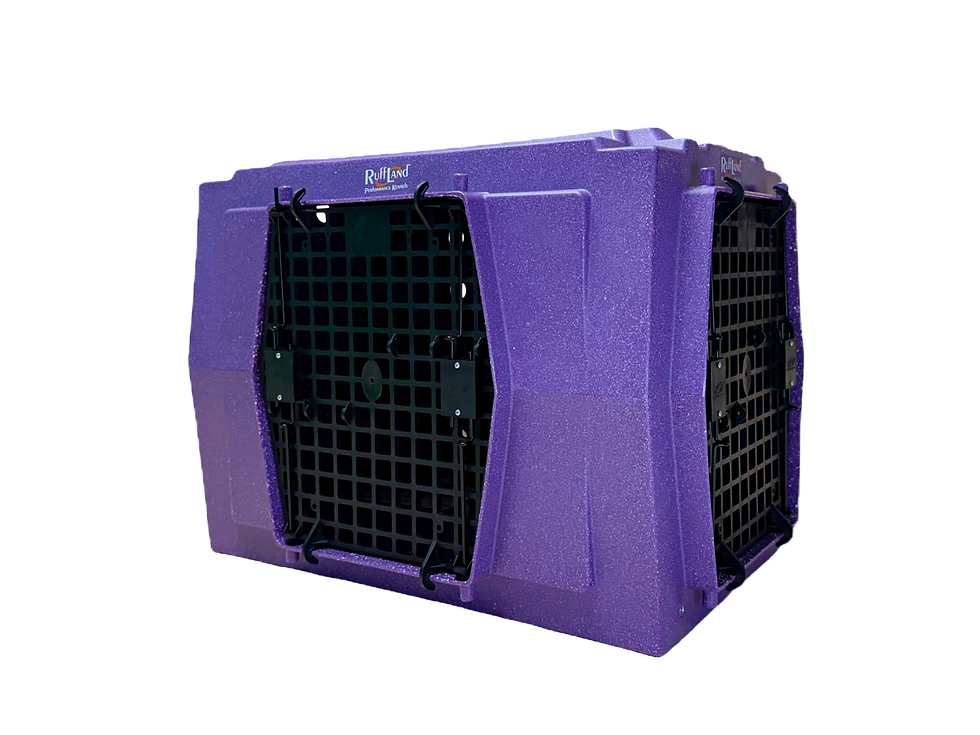
What you get: Front door plus a door on the left side (when facing the kennel from the front).
Why this matters: Mirror image of the front-and-right configuration, optimized for left-side access.
Best for:
Truck beds (driver side): If you prefer accessing your kennel from the driver's side of your truck bed.
SUV driver-side access: When it's more convenient to reach the kennel from the driver-side rear door.
Specific vehicle layouts: Some vehicles have storage or other obstacles on one side, making one-side access clearly better than the other.
Driveway/parking considerations: If you always park with the driver's side accessible (against a curb, in your driveway, etc.), this configuration makes sense.
Real-world example: A hunter I work with has his XL RuffLand in his truck bed. He backs into his driveway with the truck bed facing his garage. He always accesses the kennel from the driver's side because that's the side facing open space. The left door configuration is perfect for his setup.
Pro tip: Consider your parking situation. Which side of your vehicle is typically open and easy to access? That's the side door you want.
Configuration 4: Front and Back Door
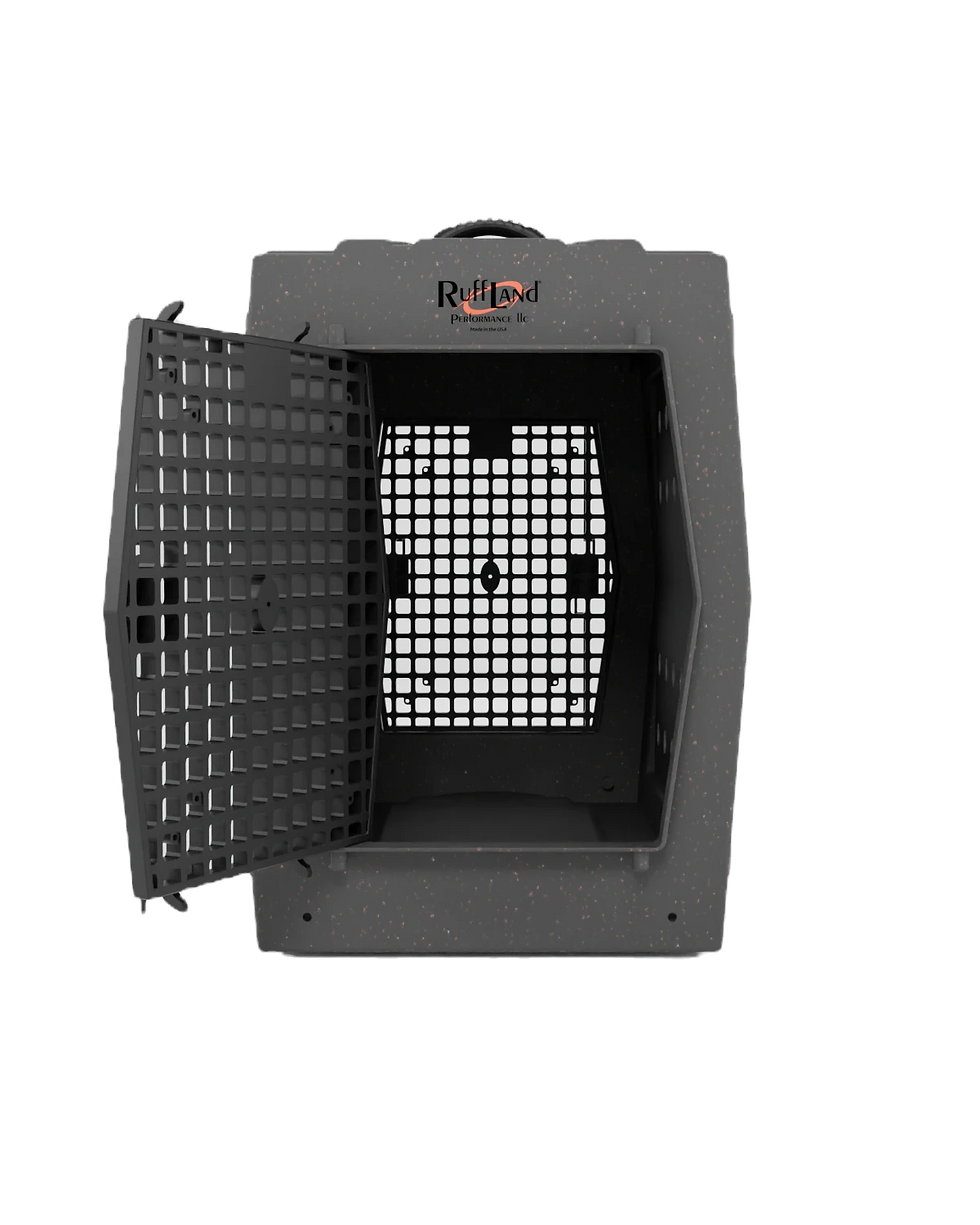
What you get: Doors on both short ends of the kennel—front and back access.
Why this matters: This gives you 180° flexibility in how you orient the kennel without needing side access.
Best for:
Changing cargo needs: If you sometimes need to flip the kennel around to accommodate other gear, this configuration lets you maintain access regardless of orientation.
Multi-dog situations: One dog can exit from the front while another stays put, or you can separate access points for dogs who need space.
Flexible home placement: You can place the kennel in different locations (corner, against wall, middle of room) and always have access from one end or the other.
Vehicle changes: If you switch between vehicles or regularly reorganize your cargo area, front-and-back gives you options without relying on side access.
Real-world example: A client with two Australian Shepherds uses a Large RuffLand with front-and-back doors. She can load both dogs through the same kennel if needed (one enters front, one enters back), or use it for a single dog with maximum access flexibility. She also switches between her SUV and her husband's truck, and this configuration works in both vehicles.
Pro tip: This is the "I want options but don't need side access" configuration. It's particularly good if your vehicle's cargo area makes side access impractical.
How to Choose: The Decision Framework
Let me walk you through the questions I ask customers to help them choose:
Question 1: Where will the kennel spend most of its time?
Mostly in vehicle, rarely moved: You need to optimize for vehicle access. Think about your specific vehicle layout and where the kennel will sit.
Mostly at home, occasional vehicle use: Single front door is probably fine. You'll position it optimally at home, and occasional vehicle trips can work around a single access point.
Split between home and vehicle: Consider which door configuration works best for your vehicle, since that's typically the more constrained environment.
Question 2: How is your vehicle configured?
Rear-loading SUV/hatchback with good access: Single front door works great. Just face the front toward the rear cargo door.
Truck bed: Do you access from the side or from the rear with the tailgate down? This determines whether you need a side door and which one.
Tight parking situations: If you frequently park with limited rear access (tight garages, parallel parking, etc.), you'll want a side door option.
Multiple vehicles: If you use the kennel in different vehicles, you might need more flexibility than a single door provides.
Question 3: How do you load your dog?
Easy loader, no issues: Access point matters less. Your dog will hop in from wherever you open the door.
Hesitant or older dog: You might want the flexibility to approach from whichever angle is easiest for your dog on a given day.
Large/heavy dog needing assistance: Consider which access point gives you the best leverage and body positioning to help your dog in and out.
Question 4: Will your situation change?
Stable situation: If your vehicle, home layout, and routine are consistent, optimize for your current setup.
Likely changes: If you might move, get a different vehicle, or change your routine, more doors = more adaptability.
Growing puppy: If you're buying for a puppy who will size up, consider that you might reorganize how you use the kennel as they grow.
Real-World Scenarios and Recommendations
Let me give you some examples of actual customers and what I recommended:
Scenario 1: Sarah - Lab owner, SUV cargo area, always loads from rear
Dog: 70 lb Labrador Retriever
Kennel: Large RuffLand
Vehicle: Honda CR-V, kennel in cargo area
Recommendation: Single Front Door
Why? Sarah's setup is straightforward. The kennel sits in her cargo area with the front door facing the rear hatch. She always loads from the same place, has good access, and doesn't need flexibility. The single door configuration saved her money without sacrificing functionality.
Two years later: Sarah tells me she's never once wished she had another door. For her needs, single door was perfect.
Scenario 2: Mike - GSP owner, truck bed, parks in tight garage
Dog: 65 lb German Shorthaired Pointer
Kennel: Intermediate RuffLand
Vehicle: Ford F-150, kennel in truck bed
Recommendation: Front and Right Door
Why? Mike's truck bed is accessible from the side, and he parks in a garage where he can't fully drop the tailgate without hitting the wall. He approaches the truck from the passenger side (right side) to access the kennel. The right-side door was essential for his setup.
Two years later: Mike says the right-side door "makes his life so much easier." He occasionally uses the front door when he's loading from the tailgate at hunting spots, but daily garage access is all about that side door.
Scenario 3: Jenny - Aussie owner, switches between vehicles, training facility use
Dog: 50 lb Australian Shepherd
Kennel: Intermediate RuffLand
Vehicles: Sometimes her SUV, sometimes her husband's truck, sometimes at training facility
Recommendation: Front and Back Door
Why? Jenny needed maximum flexibility without specifically needing side access. The front-and-back configuration lets her orient the kennel differently depending on which vehicle she's in or where she sets up at the training facility.
Two years later: Jenny says she uses both doors regularly—front door in her SUV, back door in the truck when it's more convenient, and alternates at the training facility depending on where she parks.
Common Mistakes People Make
Let me save you from the mistakes I've seen:
Mistake 1: Buying Single Door to Save Money, Then Regretting It
This happens when buyers focus only on price and don't think through their actual access needs. Six months later, they're frustrated every time they have to awkwardly reach into the kennel or rearrange cargo to get access.
How to avoid: Spend 10 minutes thinking about your vehicle layout and access patterns. If there's ANY scenario where you'd want a second door, pay the extra money now.
Mistake 2: Buying the Wrong Side Door
Getting a right-door configuration when you actually approach from the left (or vice versa) is surprisingly common. People don't visualize their approach pattern carefully.
How to avoid: Walk out to your vehicle RIGHT NOW. Open the cargo area. Stand where you'd naturally stand to access the kennel. Which side are you on? That's the side door you need.
Mistake 3: Overthinking It
Some people agonize over door configurations when their needs are actually simple. If you have straightforward access and don't anticipate changes, don't overcomplicate it.
How to avoid: If you can't think of a specific scenario where you'd need a second door, you probably don't need one.
Mistake 4: Not Considering Future Changes
Buying for your current vehicle without thinking about what happens if you get a different vehicle, move to a new house with different parking, or change your routine.
How to avoid: If there's any chance your situation will change in the next 5 years, lean toward more flexibility.
Special Considerations for Different Dog Types
Working Dogs and Hunters
If your dog works in the field and travels regularly in a truck bed, side-door access is often essential. You're loading muddy dogs, dealing with gear, and working in various conditions. The flexibility matters.
Recommendation: Front-and-right or front-and-left, depending on your truck bed access preference.
Senior Dogs or Dogs with Mobility Issues
Older dogs or dogs with arthritis/hip issues may need help getting in and out. Having multiple access points lets you approach from whatever angle gives you the best leverage to assist them.
Recommendation: Front-and-back or a side-door configuration, depending on your vehicle layout.
Anxious or Reactive Dogs
Some dogs do better loading from certain angles—away from busy parking lots, from the quiet side of your vehicle, etc. Multiple doors give you options to reduce stress.
Recommendation: Whatever configuration gives you the most flexibility to approach your dog from calm environments.
Escape Artists
Dogs who are clever about escaping don't care how many doors you have—they care about latch security. RuffLand's latches are excellent regardless of configuration.
Recommendation: Focus on proper latching habits and crate training, not door configuration.
Size-Specific Buying Guide
Let me give you a quick-reference guide for each size:
Small (5-15 lbs)
Available: Single Front Door only
My take: Perfect for the size—you don't need options
Best uses: Travel, home crating, back seat placement
Mid-Size (15-25 lbs)
Available: Single Front Door only
My take: Totally adequate—light enough to reposition
Best uses: Compact dogs, easy portability, flexible placement
Medium (25-40 lbs)
Available: Front and Back Door only
My take: Great versatility without side-door complexity
Best uses: Medium dogs in SUVs, flexible orientation needs
Upgrade from single door? If you ever need to flip the kennel around, yes
Intermediate (40-60 lbs)
Available: All four configurations
My take: This is where door choice really matters—think carefully
Most popular: Front and Right or Front and Left
Maximum flexibility: Front and Back for orientation options
Large (50-80 lbs)
Available: All four configurations
My take: Don't cheap out—get the doors you need
Most popular: Side doors for hatch use
Best value: Front and side (whichever side you need)
When to get Front and Back: Multi-dog use or frequently changing setups
X-Large (80+ lbs)
Available: All four configurations
My take: At this size, kennel isn't moving much—optimize for your vehicle
Most popular: Side doors for truck bed convenience
Key consideration: Big dogs need good access angles—choose doors that help
When single door works: Dedicated rear cargo area with excellent access
How to Visualize Before You Buy
Here's my process for helping customers choose:
Step 1: Measure Your Space
Get the exterior dimensions of your chosen kennel size and actually measure where it will sit in your vehicle. Use a cardboard box of similar dimensions if it helps you visualize.
Step 2: Mark Your Access Points
Stand where you'd naturally load your dog. Can you comfortably reach the front door? If that access point were blocked, where would you want a second door?
Step 3: Simulate Your Routine
Walk through your typical routine: "I open my rear hatch, slide the kennel forward, open the front door, dog loads. Then I slide it back into position."
Now simulate a challenging scenario: "I'm parallel parked. I can't open my rear hatch. Where would I need to access the kennel from?"
If you can't imagine needing a second access point in ANY scenario, single door is fine.
If you identified even one scenario where a second door would help, it's worth the investment.
Step 4: Consider Your Timeline
Is this kennel for a 10-year-old dog who's only got a few years left, or a puppy who'll use this for the next decade? Short-term thinking might favor single door; long-term thinking favors flexibility.
Frequently Asked Questions
"Can I add a door later if I realize I need it?"
No. RuffLand kennels are single-piece roto-molded construction. The doors are molded into the design—you can't retrofit or add doors after purchase. Choose wisely the first time.
"Do more doors weaken the kennel structure?"
Not meaningfully. RuffLand engineers their kennels to maintain structural integrity regardless of door configuration. I've never seen a structural failure related to having multiple doors.
"Is there a weight difference between configurations?"
Minimal—maybe a pound or two difference due to additional hardware. It's not a meaningful consideration.
"What if I choose wrong?"
You can resell RuffLand kennels pretty easily on local marketplaces or dog-specific forums. They hold value well. But obviously, choosing right the first time is better.
"Do side doors affect how the kennel fits in tight spaces?"
Only in that the door has to swing open (like any door). Make sure you have clearance for the door to open fully when considering side doors in truck beds or tight cargo areas.
My Final Recommendation
If I'm being completely honest, here's what I tell most customers:
For Small and Mid-Size: You don't have a choice, and that's fine—single front door works perfectly at these sizes.
For Medium: Front-and-back is the only option, and it's a good one. You'll appreciate the flexibility.
For Intermediate, Large, and X-Large: Really think about your vehicle access. Most people should get a side door (right or left) in addition to the front door. It's worth the extra cost for the flexibility.
The only people who should get single front door on larger sizes are those with VERY straightforward access needs. And even then, I gently suggest considering the upgrade.
The people who regret their door choice are almost always people who went with single door to save money, then found themselves in situations where a second door would have made life easier.
The people who get multiple doors rarely say "I wish I hadn't paid for that extra door." At worst, they say "I mostly use the front door, but it's nice to have the option."
Choose the configuration that gives you flexibility. Your future self will thank you.
Ready to Order?
Now that you understand RuffLand's door configurations and how to choose the right one, you're ready to make a confident purchase.
Here's your action plan:
Confirm your kennel size (based on your dog's measurements)
Identify your primary access needs (vehicle layout, parking situation)
Choose your door configuration (using the decision framework above)
Order with confidence knowing you've made an informed choice
Still not sure which configuration is right for you? I'm happy to talk through your specific situation. Call me at 704-774-6326 or email office@adogslifetraining.com. I'd rather spend 10 minutes helping you choose the right setup than have you second-guess your decision later.
Ready to order now? Browse our full RuffLand collection here and select your size and door configuration.
Your dog's safety and your convenience both matter. Get the doors you need—you won't regret it.
About the Author: Samantha Scarborough is a professional dog trainer and authorized RuffLand dealer based in Kannapolis, NC. She's helped hundreds of customers choose the right kennel configuration for their needs and uses RuffLand kennels extensively in her training business. When she's not working with dogs, you'll find her exploring dog-friendly trails around Charlotte with her own dogs—safely secured in their RuffLand kennels, of course.


